Friday, December 10, 2021

Digital arf

***
Ah my dear
analog doggie,

you are the last
I am walking alive.
The next longtail
will be digital.

Says St. Greta
of Dirty Air
you are really bad
to the world balance,
gassing out of
front and behind!

One day,
my digital I
will walk
analog dog
to keep the balance
of air and metal.
***

Thursday, October 15, 2020

Air and water

From all the sides of the world,
their world,
they are trying to convince us
that the air we breathe
and water we drink

are expensive,
really expensive,

that they, just they,
have even better brand
made in America
made in Switzerland
Made in Luxembourg
Made in Heavenly Heights,

and that we, yes, we!, have to
pay pay pay to

breathe
drink
live.

Go to hell, bastards, my

air
and
water

are there where
you, yes, you!,

can not
even dream.

gf

Saturday, December 21, 2019

Gigabyte P34 screen repair

This Taiwan made machine is great tool not only for gaming, but also for my professional use-as a numericist I do numerical simulations of stars.

Mine is quite ancient, 2013 machine with i7-4700HQ processor and very decent GTX 760M graphics. Ultra-slim, 1.4kg weight and Dual Thermal module for sufficient (but loud!) cooling-even in Taipei heats it holds the machine cool. In difference to similar MAC machines, it has a decent number of USB and external monitor/projector slots, and also features ethernet slot.

The only minuses I found with this machine are loud cooling fans, and risky screen hinges.

Loud fans I got used to, but hinges... destroyed it. The first sign of trouble was this:


One side of the screen just went wrong. Very wrong. First there were coloured stripes, and then just nothing. Matrix entered my life.

It was really a bad idea to put 14'' screen on two poor thin metal connections supporting the thin plastic part-yes, those two small squares at the bottom left and right, with two small holes, are the main construction elements of the screen connection to the lid!:


I really do not know what the RD was thinking when doing it. It had to break at any time, especially if one would handle it a bit harsher. With mine, it broke after 5 years, so it was not so bad. But then, I was really careful opening/closing the lid. Also, I was not using the machine every day, as I had a decent workhorse desktop at work.

Since otherwise I was very happy with this machine, I decided to extend its life as a laptop, not use it only in the desktop mode with the monitor.

I detached the plastic cover-be careful with wires, not to break any when un-sticking the front cover (use e.g. old credit card to get below it-and got to the screen itself.


I tried to press the plastic bar with electronics in the powering of the screen to see if the problem is there-yes, something inside got broken obviously. At this point the only what remains is to find exactly the same screen. Information found online told me that this sticker on the screen has all needed to buy the new one:


Just in case, when ordering, make certain to mention to the seller the number of pins on the main connector (30 or 40, mine was 30). The new screen, found online from a private provider, costed of the order of 100USD-not so bad, when the new machine would cost above 1000 USD. I think it pays off to make a repair if the cost is of the order of 20% of the price of the new one. Sure, the professional latop repair thought different, and they would not improvise, so I had to do it myself.

Next task is to find a way to attach the new screen so that it would not be so poorly attached as the original one. The original frame was a bad idea even when new. Now, broken in pieces, it needed serious refurbishing. I did not want to waste time on obtaining the complete new lid or parts, because I found the original construction seriously botched.

My son is a magician of making and repairing things, so he helped: a robust aluminium frame, 2 screws through the each corner of the original metal cover of the latop. Luckily, hinges were strong, so he could put screws through them. Now the LCD was just inserted into such prepared frame, and fixed into its original position with the original screws, but not working as a construction element any more.

He also made the frame little extended towards the keyboard at the front, so my keyboard does not remain imprinted on the screen when I close the lid (this was another annoying thing, but not unusual for extra-slims, and I was preventing it inserting a piece of material always when closing a lid).


Now this initially gently looking ultra-slim became a heavy-metal looking laptop:


It weights maybe 20 gr more, because of the additional frame and a bit of plastic, but I think it was worth doing. One should respect electronics, and not dispose of it just because of the mechanical failure of the badly constructed box. ps.28.11.2020: the left corner near the screen hinge broke, again, bad plastic. I could not close the lid without supporting it carefully, and had to temporarily install U-shaped metal brace that it would not go apart. Gigabyte, invest in better plastic and more robust construction, your R&D really failed here. So, laptop had to go again into the son's hands. To fill in the gap after broken screw holder he put some plastic and two new screws:
With a bit of simplest cosmetics it became useable laptop again:

Thursday, April 18, 2019

Averatec Buddy HS-103 CMOS battery

If you'd ever need to change the CMOS battery in 10 inch Averatec Buddy HS-103, you might wonder where it could be.

A youtube post instructing about disassembling the machine from one Korean user is easy to find, but is it really needed to go that far to change the battery? Unfortunately, yes, as one needs to reach the motherboard.

It is easier than it looks, just make sure you undid all the screws.

Beware to unscrew the middle screw keeping the keyboard, from the opposite side of the machine!, youtube post did not dwell on this enough and I found myself needing some time to understand where is the problem.

To reach the battery, you do not need to disconnect the keyboard cable, it is safer to just lift the upper part of the machine, not to disconnect the cable.

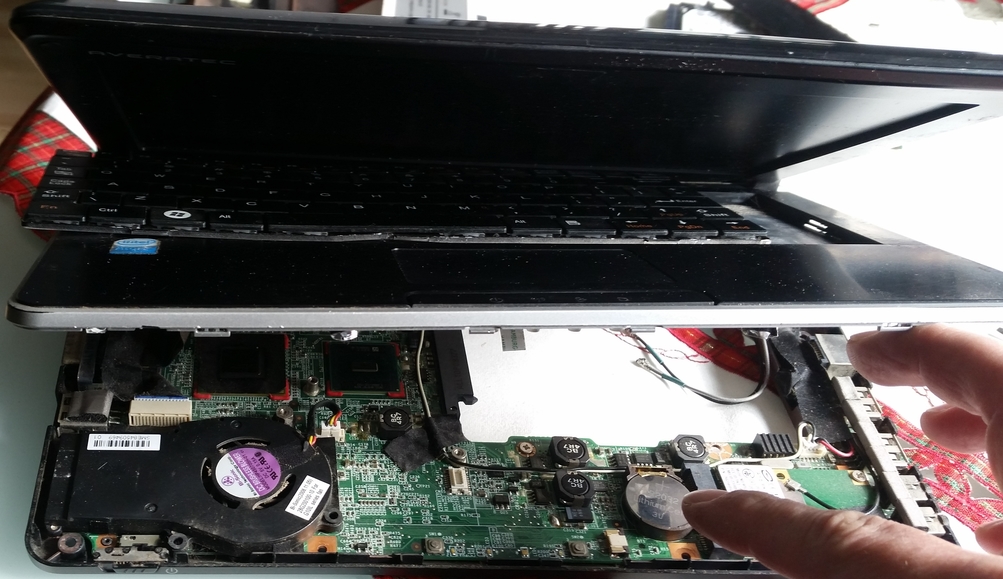
The battery is here:


It is a standard flat CR 2032 battery, covered with a protective foil, just remove it (and put back after inserting the new one).

I really appreciate this little machine. After more than 10 years of use, it still runs nice (under Linux, sure!), especially after adding 2GB RAM. Its hardware is really robust! Good job, Uniwill!

Thursday, July 19, 2018

Oksanen's "Purge"

There are books which should not be written. And for certain not by their
respective authors. "Purge" by the Estonian/Finnish writer Sofi Oksanen is
one of those.

Superbly written text gave me shivers not once and, to be sure, the above
statement is all about the content, not about the author's skill. It is
expressing my frustration by the topic.

The story is simple and all too known: people caught in the historical
events, killed, raped, tortured and psychically tormented by the effects of
that.

Intertwinning of the 1990-ies story with the events about and after the WWII
is a less usual mixing, and Oksanen ingeniously does it. Together with the
family which is a multiple victim of war, the grand-daughter becomes a victim
of human trafficking and forcing to prostitution. In effect, she becomes
equal to the previous victims of war.

Why I wrote a young, too young writer Sofi Oksanen (being at the beginning
of her 30-ies when writing it!) should not write such a story? She is describing
the bestiality of men. And women. In her writing I felt the vibes of Jens
Bjorneboe, another chronicler of human bestiality. He perfidly and exactly
noted down, jotted down, what disgusting things small bears can do to the other
small bears. It is not something a young person should know.

But obviously she did. And what to do with it.

What strikes in her writing is the fact that she knew so well to put equal the
suffering of both "sides". There is no sides when it comes to suffering,
especially the suffering of war and its aftermath.

It all is abomination, and it is something so well shown in this writing.
Tormentors were, are the tormented, criminals are, ironically, merely the
executors of justice.

Who could like such a world? And it is the reality of too many, too many people.

Goodbye to Reason, indeed!

Friday, May 18, 2018

Lawrence Durrell's "Judith"

The unpublished novel by this of Masters, published in 2012 (he died in
1990), was written at the beginning of 1960-ies as a screenplay for the
Paramount Pictures movie by Daniel Mann featuring Sophia Loren. At the end,
Durrell withdrew from the movie production (probably unsatisfied with the
needed changes). The similar fate was with his earlier engagement with the
Twentieth Century-Fox in the making of the "Cleopatra".

While still working on it, Sophia Loren asked Durrell to change the main
character, played by her, from the Lady-professor to the wife and mother,
as "she is not an intelectual type", and he did so, producing two parallel
texts, which he was considering to publish as a "Double scenario" book,
which did not happen, he abandoned the text.

His success as a writer after the publication of "Justine", the first part
of "The Alexandria Quartet", brought Durrell offers of work on the
screenplays, but he was more focused on his artistic work than such
ventures. Still, as in his top writings, in those "side works" he also
investigated thoroughly the locations and state of matters and paid attention
to the structure of the work. "Judith" was a part of his 2nd tier works,
which, for him, was a kind of fermentation of thoughts and rest between the
major works. Durrell was a compulsory writer, and needed many vents for his
artistic personality.

I met with people who considered Durrell mildly, if not strongly
anti-semitic, based on some of his writings. But, of his 4 wives, 2 were Jewish,
and I do not remember ever reading any evil statements or feelings he would
express... But then, he did not belong to the overly politically correct writers,
and some of his comments could be taken out of context and presented in this or
that way. When writing about French Resistance in "The Avignon Quintet" in not
exactly glorifying terms, or similarly about Arabs in many of his works, he did
not show any hate or animosity. Only normal contempt for the human stupidity where
things could, with a little of clear thinking, be easily converted into something
constructive, not destructive, as it was usually the case.

In "Judith" he did exactly the opposite from anti-semitic, from every line
one can feel his sympathy with the Jewish case, and contempt for the
surrounding circumstances of the birth of the Israel, from the collapse of
the British Mandate to the petty plotting of the Arabs.

I do not know much about the events of the Mandate, and especially the fact
that Israel was fought for, not plainly given by the world main players, was
appropriately exposed in "Judith". My impresion is that the fight Israel won
at the time against Arabs gave the country legitimity as any other country,
including my own Croatia just recently...and the rest is in the hands of
more or less dirty politycs. Israel is a fact. As are Arabs, and a sensible
solution for the problem is to be found, or there will be more and more of
the senseless killing.

I learned a pile from the book, and if Durrell is not the most exact of the
historians, I never found him being an evil one. In difference to the too many
of the "official", and in fact doctrinary, historians, or rather propheths of
the one or other national identity.

This book, published only recently from the writings in his documentation,
definitely deserves its place between his other works. He considered it of so
little artistic value that he even did not publish it, but many authors would
love to be able to have such a work in their meter or so of the books on the bookshelf.

Saturday, January 6, 2018

Ph.K.Dick's Transmigration

As I predicted in the recent post
I could not resist to torture myself and read the third-and the last,
thanks to the Skies!-part of the Ph.K. Dick's "VALIS" trilogy:
"The transmigration of Timothy Archer". In fact the trilogy's
final part was supposed to be "The owl in daylight", his unfinished
novel, for which he collected advance money from the publisher. But
he died before he even thought out the plot or defined the
characters. There is a discussion about the "Trilogy", but
PKD himself called "The transmigration..." part of the trilogy,
because of the common theme.

It seems with time of writing the subsequent novels, PKD's amount of
amphetamine or whatever he was using was getting smaller, as the amount
of unreadable religio- pornography decreases somewhat towards the end of writing.

In the first part, his use of ink on VALIS is large. In the 2nd part VALIS
is mentioned only two times, and in "The transmigration...", his final
completed book, it was not mentioned at all. "The transmigration..." was
nominated for the best SF work in the year of his death, 1982, but I think
it must be like a hommage, more than the real value of the book.

Timothy Archer is an Episcopal Bishop, who really transmigrates
into not being bishop any more, but taking a lover. He gets
obsessed with find and translation of Zadokite scrolls, where is
a notion from 200 years before the Christ, which invalidates the
meaning of him as a son of God. Plot is set in 1980, and starts
with the killing of John Lennon.

The book is characterised as postmodernist and philosophical. I would
not call it none of this, but just a product of an ill mind. It might
be philosophical only for someone who learns philosophy from PKD and
history from Dan Brown. Which is not so bad, it would mean (s)he at
least reads something, not just stare in the screen.

So, in 2017 I succeeded in reading the VALIS. Was it worth the effort?

No, it was not.

Except if we follow the Marxist "learn your enemy" advice, where
"enemy" is for me the claim that VALIS would be one of top heights of the
PKD's writing. True, it has valuable moments, as PKD was, definitely,
a good writer. But good writing can not hide the heavily troubled
personality. PKD produced VALIS after a spiritual experience, which he
would not attribute to medication/drugs use. I think that such text could
be brewed only in the USA, and later it is accepted (more or less) elsewhere
based on the placebo effect of ... thinking.