Sunday, October 5, 2025

Children

Children, our children,
we failed to teach
dying for ideas
reading under candels
helping without interest,
going for it, clueless

Children, our children,
learned on our example
that Lie is too big

Children, our children,
witness all around
that if you do not take
you do not have.

Thursday, October 2, 2025

Ph.K.Dick, Our friends from Frolix 8

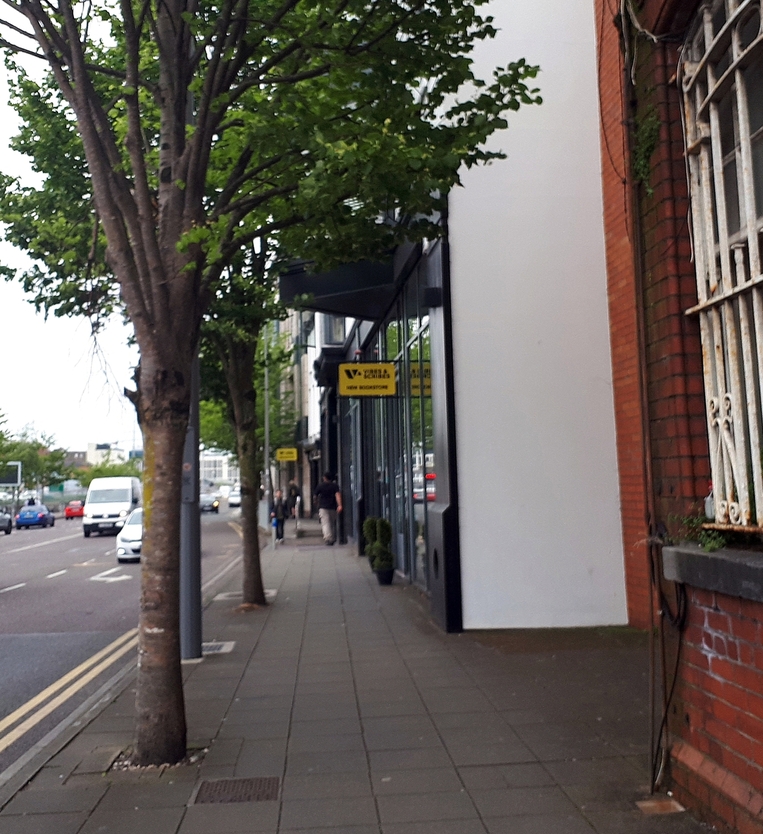
Backlog of my writing here shows that I was educating myself regarding PKD since years. My wish to go through VALIS trilogy was the reason for my revisiting PKD, and as usual, I do things thoroughly. The most recent entry, which I report here, I found in the 2nd-hand book store Vibes and Scribes in Cork, Ireland, where I went for the annual European Astronomical Meeting. It is a good, well equipped store, actually two stores in adjacent buildings, one with new, and other with used books, a very good concept, see pic, the two entrances marked with the same name plate. This text is a less known work of PKD, but I think it should be more widely known.

It was first published in 1970, so in his pre-revelation (March 1974) phase, but I find all the signs of VALIS there. The world is in complete turmoil, here because the ruling castes, New Men and Unusuals, who are Huxleyan Alphas and Betas, fail to prevent the uprise of the under-caste group, the Old Men. Intellectual supremacy is not the requisite ensuring ability to prevail in ruling position. It is, still, dependent on subordinates to work effectively.

PKD ingeniously follows the rebel fraction and shows the ultimate failure of such a system, and its succumbing, when challenged, to Alien supremacy. Aliens are presented by a slimy (literally) intelligence, which burns the New Men's brains, effectively leaving them in a post-lobotomic, childish state before their ultimate demise.

In the description of society before those events, PKD follows Huxley and Orwell and, in addition, delineates the deception, which he later formulated more in detail in VALIS. The deception of freedom is here just alluded to-the ultimate motivation of the Alien being is left uncovered. It could be really positive, but equally well it could be that it is just tricking the Humanity for its alien purpose.

I think this novel shows that the birth of his "vision" was much in advance to tooth extraction episode. It is his brain, not a conspicous mixture of medication, which brings him to "Revelation". I find it hillarious that in "Our friends..." he describes the drug bars, in a world where alcochole is stricly forbidden as harmful substance. Very prophetic, I think!

Weird, out of its time story, even for a PKD. Strongly suggested, not so much for its literary value, as for its...prophetic charge. Life in the Universe might be much, much more intricate and dangerous than we can fathom.

After I wrote the above text, I read the Wikipedia entry on the novel and it says that yes, it is not the best but rather the worst of his works from that period, and that the themes were already started in some of his earlier novels. This only strenghtens my feeling that what became the VALIS later was already in his head.

Monday, November 6, 2023

Sunday, October 8, 2023

Ruins of time

For so long
we are not,
That when underground gods
grind the continents together,
our names do not figure
in the lists of missing.

We are missing
in the ruins of time.

Tuesday, July 25, 2023

Sky, memory

Memory of a sky,
other planet's sky
with flowers and rivers
impurity included,
chases me.

A memory of sky,
pure and clear
with stars shining, twinkling,
planets stalking them,
haunts me.

A sky of memory,
blue and vivid
with clouds dancing
and birds balancing,
kills me.
*

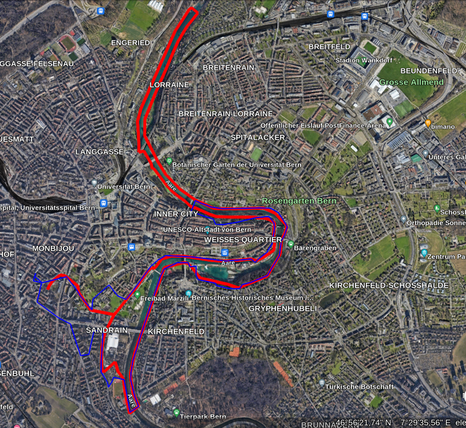
Bern runs

Bern is an essential Swiss city: expensive not only for Eastern Europeans, kind of polished, kind of not boring, kind of full of relaxed locals, svimming in the fast white-green waters of Aare river.

Bern turns out to be a kind of depressive city for me, still have to understand why. Both times I visited it, it made this impression. And it should not, so many young people, students, around, so lively and lovely, no irony. Must be just so different from my Eastern Europe experience that it is unfathomable?

To add some novelty and try to break the depressive air, this time I gave myself experience of running along the river, between two pedestrian bridges, from one side of the city to the other. Highly recommendable!

It gives you an excellent view to the city. The red one was 12 km of pure pleasure, the blue one a bit shorter, 10km. Make certain you find the exit to the river and just enjoy! The path is good and you can divert to the city at many interesting places, if you feel so.

Walking the streets and seeing the views later, with them already in your legs, gives another perspective.

Friday, December 10, 2021

Digital arf

***
Ah my dear
analog doggie,

you are the last
I am walking alive.
The next longtail
will be digital.

Says St. Greta
of Dirty Air
you are really bad
to the world balance,
gassing out of
front and behind!

One day,
my digital I
will walk
analog dog
to keep the balance
of air and metal.
***

Thursday, October 15, 2020

Air and water

From all the sides of the world,
their world,
they are trying to convince us
that the air we breathe
and water we drink

are expensive,
really expensive,

that they, just they,
have even better brand
made in America
made in Switzerland
Made in Luxembourg
Made in Heavenly Heights,

and that we, yes, we!, have to
pay pay pay to

breathe
drink
live.

Go to hell, bastards, my

air
and
water

are there where
you, yes, you!,

can not
even dream.

gf

Saturday, December 21, 2019

Gigabyte P34 screen repair

This Taiwan made machine is great tool not only for gaming, but also for my professional use-as a numericist I do numerical simulations of stars.

Mine is quite ancient, 2013 machine with i7-4700HQ processor and very decent GTX 760M graphics. Ultra-slim, 1.4kg weight and Dual Thermal module for sufficient (but loud!) cooling-even in Taipei heats it holds the machine cool. In difference to similar MAC machines, it has a decent number of USB and external monitor/projector slots, and also features ethernet slot.

The only minuses I found with this machine are loud cooling fans, and risky screen hinges.

Loud fans I got used to, but hinges... destroyed it. The first sign of trouble was this:


One side of the screen just went wrong. Very wrong. First there were coloured stripes, and then just nothing. Matrix entered my life.

It was really a bad idea to put 14'' screen on two poor thin metal connections supporting the thin plastic part-yes, those two small squares at the bottom left and right, with two small holes, are the main construction elements of the screen connection to the lid!:


I really do not know what the RD was thinking when doing it. It had to break at any time, especially if one would handle it a bit harsher. With mine, it broke after 5 years, so it was not so bad. But then, I was really careful opening/closing the lid. Also, I was not using the machine every day, as I had a decent workhorse desktop at work.

Since otherwise I was very happy with this machine, I decided to extend its life as a laptop, not use it only in the desktop mode with the monitor.

I detached the plastic cover-be careful with wires, not to break any when un-sticking the front cover (use e.g. old credit card to get below it-and got to the screen itself.


I tried to press the plastic bar with electronics in the powering of the screen to see if the problem is there-yes, something inside got broken obviously. At this point the only what remains is to find exactly the same screen. Information found online told me that this sticker on the screen has all needed to buy the new one:


Just in case, when ordering, make certain to mention to the seller the number of pins on the main connector (30 or 40, mine was 30). The new screen, found online from a private provider, costed of the order of 100USD-not so bad, when the new machine would cost above 1000 USD. I think it pays off to make a repair if the cost is of the order of 20% of the price of the new one. Sure, the professional latop repair thought different, and they would not improvise, so I had to do it myself.

Next task is to find a way to attach the new screen so that it would not be so poorly attached as the original one. The original frame was a bad idea even when new. Now, broken in pieces, it needed serious refurbishing. I did not want to waste time on obtaining the complete new lid or parts, because I found the original construction seriously botched.

My son is a magician of making and repairing things, so he helped: a robust aluminium frame, 2 screws through the each corner of the original metal cover of the latop. Luckily, hinges were strong, so he could put screws through them. Now the LCD was just inserted into such prepared frame, and fixed into its original position with the original screws, but not working as a construction element any more.

He also made the frame little extended towards the keyboard at the front, so my keyboard does not remain imprinted on the screen when I close the lid (this was another annoying thing, but not unusual for extra-slims, and I was preventing it inserting a piece of material always when closing a lid).


Now this initially gently looking ultra-slim became a heavy-metal looking laptop:


It weights maybe 20 gr more, because of the additional frame and a bit of plastic, but I think it was worth doing. One should respect electronics, and not dispose of it just because of the mechanical failure of the badly constructed box. ps.28.11.2020: the left corner near the screen hinge broke, again, bad plastic. I could not close the lid without supporting it carefully, and had to temporarily install U-shaped metal brace that it would not go apart. Gigabyte, invest in better plastic and more robust construction, your R&D really failed here. So, laptop had to go again into the son's hands. To fill in the gap after broken screw holder he put some plastic and two new screws:
With a bit of simplest cosmetics it became useable laptop again:

Thursday, April 18, 2019

Averatec Buddy HS-103 CMOS battery

If you'd ever need to change the CMOS battery in 10 inch Averatec Buddy HS-103, you might wonder where it could be.

A youtube post instructing about disassembling the machine from one Korean user is easy to find, but is it really needed to go that far to change the battery? Unfortunately, yes, as one needs to reach the motherboard.

It is easier than it looks, just make sure you undid all the screws.

Beware to unscrew the middle screw keeping the keyboard, from the opposite side of the machine!, youtube post did not dwell on this enough and I found myself needing some time to understand where is the problem.

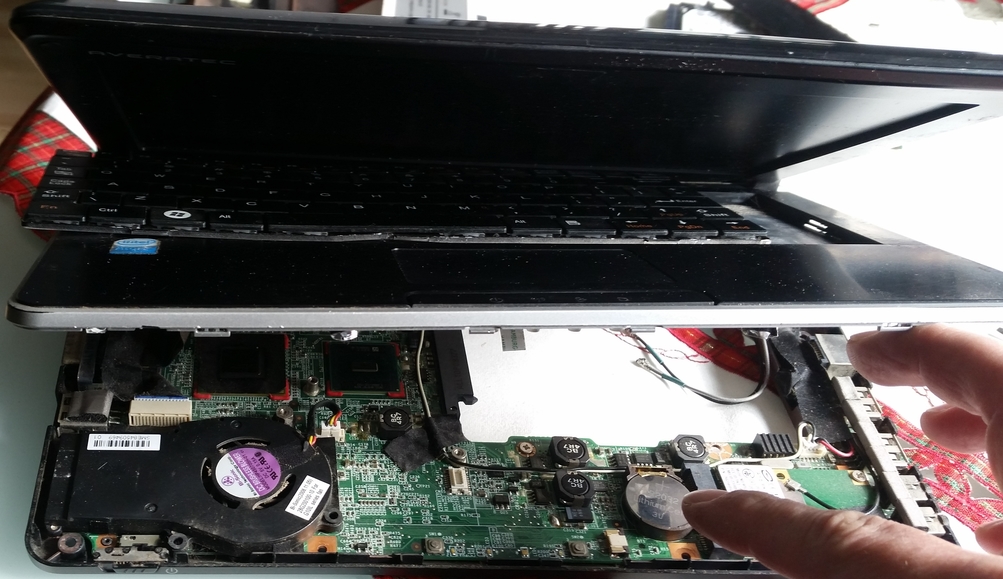
To reach the battery, you do not need to disconnect the keyboard cable, it is safer to just lift the upper part of the machine, not to disconnect the cable.

The battery is here:


It is a standard flat CR 2032 battery, covered with a protective foil, just remove it (and put back after inserting the new one).

I really appreciate this little machine. After more than 10 years of use, it still runs nice (under Linux, sure!), especially after adding 2GB RAM. Its hardware is really robust! Good job, Uniwill!

Thursday, July 19, 2018

Oksanen's "Purge"

There are books which should not be written. And for certain not by their
respective authors. "Purge" by the Estonian/Finnish writer Sofi Oksanen is
one of those.

Superbly written text gave me shivers not once and, to be sure, the above
statement is all about the content, not about the author's skill. It is
expressing my frustration by the topic.

The story is simple and all too known: people caught in the historical
events, killed, raped, tortured and psychically tormented by the effects of
that.

Intertwinning of the 1990-ies story with the events about and after the WWII
is a less usual mixing, and Oksanen ingeniously does it. Together with the
family which is a multiple victim of war, the grand-daughter becomes a victim
of human trafficking and forcing to prostitution. In effect, she becomes
equal to the previous victims of war.

Why I wrote a young, too young writer Sofi Oksanen (being at the beginning
of her 30-ies when writing it!) should not write such a story? She is describing
the bestiality of men. And women. In her writing I felt the vibes of Jens
Bjorneboe, another chronicler of human bestiality. He perfidly and exactly
noted down, jotted down, what disgusting things small bears can do to the other
small bears. It is not something a young person should know.

But obviously she did. And what to do with it.

What strikes in her writing is the fact that she knew so well to put equal the
suffering of both "sides". There is no sides when it comes to suffering,
especially the suffering of war and its aftermath.

It all is abomination, and it is something so well shown in this writing.
Tormentors were, are the tormented, criminals are, ironically, merely the
executors of justice.

Who could like such a world? And it is the reality of too many, too many people.

Goodbye to Reason, indeed!

Friday, May 18, 2018

Lawrence Durrell's "Judith"

The unpublished novel by this of Masters, published in 2012 (he died in
1990), was written at the beginning of 1960-ies as a screenplay for the
Paramount Pictures movie by Daniel Mann featuring Sophia Loren. At the end,
Durrell withdrew from the movie production (probably unsatisfied with the
needed changes). The similar fate was with his earlier engagement with the
Twentieth Century-Fox in the making of the "Cleopatra".

While still working on it, Sophia Loren asked Durrell to change the main
character, played by her, from the Lady-professor to the wife and mother,
as "she is not an intelectual type", and he did so, producing two parallel
texts, which he was considering to publish as a "Double scenario" book,
which did not happen, he abandoned the text.

His success as a writer after the publication of "Justine", the first part
of "The Alexandria Quartet", brought Durrell offers of work on the
screenplays, but he was more focused on his artistic work than such
ventures. Still, as in his top writings, in those "side works" he also
investigated thoroughly the locations and state of matters and paid attention
to the structure of the work. "Judith" was a part of his 2nd tier works,
which, for him, was a kind of fermentation of thoughts and rest between the
major works. Durrell was a compulsory writer, and needed many vents for his
artistic personality.

I met with people who considered Durrell mildly, if not strongly
anti-semitic, based on some of his writings. But, of his 4 wives, 2 were Jewish,
and I do not remember ever reading any evil statements or feelings he would
express... But then, he did not belong to the overly politically correct writers,
and some of his comments could be taken out of context and presented in this or
that way. When writing about French Resistance in "The Avignon Quintet" in not
exactly glorifying terms, or similarly about Arabs in many of his works, he did
not show any hate or animosity. Only normal contempt for the human stupidity where
things could, with a little of clear thinking, be easily converted into something
constructive, not destructive, as it was usually the case.

In "Judith" he did exactly the opposite from anti-semitic, from every line
one can feel his sympathy with the Jewish case, and contempt for the
surrounding circumstances of the birth of the Israel, from the collapse of
the British Mandate to the petty plotting of the Arabs.

I do not know much about the events of the Mandate, and especially the fact
that Israel was fought for, not plainly given by the world main players, was
appropriately exposed in "Judith". My impresion is that the fight Israel won
at the time against Arabs gave the country legitimity as any other country,
including my own Croatia just recently...and the rest is in the hands of
more or less dirty politycs. Israel is a fact. As are Arabs, and a sensible
solution for the problem is to be found, or there will be more and more of
the senseless killing.

I learned a pile from the book, and if Durrell is not the most exact of the
historians, I never found him being an evil one. In difference to the too many
of the "official", and in fact doctrinary, historians, or rather propheths of
the one or other national identity.

This book, published only recently from the writings in his documentation,
definitely deserves its place between his other works. He considered it of so
little artistic value that he even did not publish it, but many authors would
love to be able to have such a work in their meter or so of the books on the bookshelf.

Saturday, January 6, 2018

Ph.K.Dick's Transmigration

As I predicted in the recent post
I could not resist to torture myself and read the third-and the last,
thanks to the Skies!-part of the Ph.K. Dick's "VALIS" trilogy:
"The transmigration of Timothy Archer". In fact the trilogy's
final part was supposed to be "The owl in daylight", his unfinished
novel, for which he collected advance money from the publisher. But
he died before he even thought out the plot or defined the
characters. There is a discussion about the "Trilogy", but
PKD himself called "The transmigration..." part of the trilogy,
because of the common theme.

It seems with time of writing the subsequent novels, PKD's amount of
amphetamine or whatever he was using was getting smaller, as the amount
of unreadable religio- pornography decreases somewhat towards the end of writing.

In the first part, his use of ink on VALIS is large. In the 2nd part VALIS
is mentioned only two times, and in "The transmigration...", his final
completed book, it was not mentioned at all. "The transmigration..." was
nominated for the best SF work in the year of his death, 1982, but I think
it must be like a hommage, more than the real value of the book.

Timothy Archer is an Episcopal Bishop, who really transmigrates
into not being bishop any more, but taking a lover. He gets
obsessed with find and translation of Zadokite scrolls, where is
a notion from 200 years before the Christ, which invalidates the
meaning of him as a son of God. Plot is set in 1980, and starts
with the killing of John Lennon.

The book is characterised as postmodernist and philosophical. I would
not call it none of this, but just a product of an ill mind. It might
be philosophical only for someone who learns philosophy from PKD and
history from Dan Brown. Which is not so bad, it would mean (s)he at
least reads something, not just stare in the screen.

So, in 2017 I succeeded in reading the VALIS. Was it worth the effort?

No, it was not.

Except if we follow the Marxist "learn your enemy" advice, where
"enemy" is for me the claim that VALIS would be one of top heights of the
PKD's writing. True, it has valuable moments, as PKD was, definitely,
a good writer. But good writing can not hide the heavily troubled
personality. PKD produced VALIS after a spiritual experience, which he
would not attribute to medication/drugs use. I think that such text could
be brewed only in the USA, and later it is accepted (more or less) elsewhere
based on the placebo effect of ... thinking.

Monday, December 25, 2017

Orphan of Asia

"Orphan of Asia" by Zhuoliu Wu is a strangely modern book-from 1945.
It is my second reading of this book, after almost exactly 8 years, and
I still had a lot to learn. After 2009 I spent a substantially different
5 years in Taiwan than the previous 5 years, and learnt it from the other angle.
With the distance I have now, 3 years after returning to Europe, I start
seeing the experience of Taiwan in yet another light.

The book was written in Japanese language, at the time when Japan was
just ceasing to be a heavenly ruler of Asia, and some other more earthly
masters went into ruling it. Taiwan just stopped being the Japan proper,
and soon became a dumping place for Chinese failures of Nationalists:
Kuomintang party of China took over, with help of their beastly losers.
But this is still to befell on Taiwan- in the time of writing, it is a
Japanese backwater, where Masters are teaching their underlings to be
human, that is, Japanese.

Taiming, a boy from the mountain village, knows nothing of it-as
was, and still is, the case with so many a Taiwanese boys (even at
the age of over 50) today. He starts his classical Chinese education
with a master in the mountains, an opiate addict, who lives a virtual
classical Chinese life in a seclusion. Boys play, but also soak into
the mind-narrowing classical learning. Which, after all, is what makes
Chinese being Chinese: an anachronism, almost an atavism, which survives
until today because of sheer powers of life.

Nothing less could explain how such an impenetrable culture, which
virtually prevents dissemination of knowledge to its population (c'mon,
15 years of hard work just to learn to read and write?!). Probably the
explanation is that for a human society to thrive, having only basic
education is better than giving wide knowledge to everyone-it just brings
problems. It is much, much easier to govern a stupid, uninformed mass of
people, than a well educated body of citizens. This is why Heavenly Empire
of the Country of the Middle was one of the last empires to fall. And when
it fell, it fell to a similarly stupefying mindset, which immediately brought
caricatures (in bad taste) of any free minded thought.

Taiming actually succeds, he goes to Japan to study, but because of his low
(=Taiwanese) background, fails to obtain appropriate position in the
Japanese driven society. He is utterly rejected.

When he moves to China, he is rejected doubly, as a Japanese subject, but
even more as a Taiwanese. To be able at all to work in China, he has to
hide that he is Taiwanese, so low is the esteem his compatriots have in China.

The fact of being a Japanese subject at a time of WWII, complicates the
things, and he has to flee back to Taiwan. Interestingly enough, he did not
make a fame there-people of his stature, with university diplom from Japan,
were not many. But again, as a non-Japanese he did not really have a chance,
and his lack of zeal for sacrifying his life on the altar of Imperium, did
not help. He was conscripted into army, and went into fight on the mainland,
but so disgusted he was with what he saw there-and from the hands of his own
army, Japanese soldiers-that he just went crazy, literally, and was
repatriated as inept for the service.

Back home, he recovered, but with a new distance to everything going on
around him. He went to introspection again, and slowly, painfully, he
allowed to himself to be what he really is.

But this does not stop the course of history, and Taiwan did not get well in
the troubled waters. When his family suffers, Taiming feels he himself was
responsible for it-as the best educated person from his village, he should
do more to protect them. In his introspective way he takes the blame and
goes crazy, this time for good. For him, a Taiwanese, immersed in the
deeply troubled identity of a non-nation, the historical moment was too
much.

In the first reading I more saw his troubled, confused personality, than the
persistence with which he tried not to succumb to strong currents of history
around him. And fails. As Taiwan eventually failed in the XX ct., and is
only now, with the new, globalized generation, trying to define some new
identity. It will not be anything like what their forefathers could imagine
or approve, but this, exactly, is how the rough waters of history tumble the
ideas of the past into the reality of the future: sometimes they are
crashed and cast anew into a completely new form, which would be impossible
to predict at the previous level. A bit like we can not predict what will
come of the outspring of a family in few generations-they will find their ow
way.

In my life, I saw one re-birth of a nation, in my own country. But Croatia
had a history of a 1000 years, and even a pre-history (although, as it
usually goes, mixed with plenty of mythology) as a well defined Slavic
tribe. So, in not too good times of cronysm, rampant primitive
ultra-catholicism and general decay of values going on there since its
birth, there always remains the virtue of "we are ourselves doing it to
ourselves, so we probably deserve it".

"Taiwanese" were never a tribe, and definitely were never a defined
nation. It is, today, a nation to be born. That is, if Chinese Communist
Party will be too busy with itself to allow for it. On the other side, they
would never profile as a nation if there would not be a contrast and
fearsome Big Red Brother accross the sea. How they will fare the troubled
waters remains to be seen. I would give a credit to some of the youth there,
who do not want to fill the Party lines, and prefer instead a more
self-introspective mode. Which is today not less dangerous than it was in
the Taiming's time. Levi'Strauss was wrong, History, some new one, just starts, and
it is completely unpredictable.

There is another level in this book, which might be useful to Western expatriates
who find themselves puzzled by the inconsistencies in the Taiwanese everyday life.
They survived in Taiwan from the first half of the XX ct., and the writer removes
well the obscuring layers of history from some of them.

In the Columbia University Press edition, this book was a part of presenting
Taiwanese writers at the beginning of the Millenium. It was a good effort, but not
so easy to follow as it was not easy to find the books. Now, when it became easy
because of online bookstores, I will follow the other publications, to learn more.
This is one of the virtues of the new times, with which modern Taiwan fares better
than in the old, obscure and elitist ways.

Saturday, December 2, 2017

Divine invasion

In a previous post, Valis,
I prophetically wrote that I will go after continuation of Philip K. Dick's
"Valis", after I recover from the bull-shit of the 1st book. I am a certified
masochist, and I like PKD's writing, really, even when it shows he used too
much of illicit chemistry at the time of writing.

So, there I was, "The Divine Invasion". As usual for PKD, it kicked off
magnificently, with humans living on another planets as a senseless
guardians of the senselles colonization of the extrasolar worlds across
the Galaxy. And yes, they are dead, as PKD liked to have them. Or almost
dead, as they are held in criogenic suspension until organs for replacement are found.

In "Valis", God, who was a girl, Sophia, dies. Here it is reborn, in a
virgin conception which happens on another planet. Emmanuel, the boy, is
folloved closely by Elias, who is a beggar even in the alien planet. The
conception happened under the auspicion of the local alien god of a small
hill, Jah. Did we hear the story anywhere? But PKD, helped with tonnes of
good psychodelic, produces a well informed and, yes, readable version of the
story from The Scripture. It is definitely one of the best rendering of it
which I read. Halleluyah, Philip.

Emmanuel the kid devised a way to forget his own godly plans, so he could
exist in the real world, but is permanently having flashes of reminding, as
do the people around him. He is guided around by a little girl-Athena,
Diana, he guesses, but it shows to be his own adversary-or angel-a less
known Talmudic being. Belial himself appears as a small stinky black goat-and
is killed by a Linda Fox, pop singer, who is the angel, appropriately.

Still, even if less than it was the case with the first part of the trilogy,
the book is full of references to the Old Testament, and reads for long pages
as a Jehova Witness text. Not that lenghty and disturbing the flow of the story
as in "Valis", but still, unnecessary. A pity PKD, or his editor, did not
remove that.

I was asking myself what to hell do I get from this reading, should I not just
throw it away. No, I am a masochist, obviously.

I acquired the third part, and the beginning reads really well. Good for me and
the world that PKD did not produce more of it!

Thursday, November 16, 2017

Vegetarian reading Hemingway

Being vegetarian, to read and, even more, to enjoy reading "Green hills of
Africa", a classical Hemingway hunting narrative-which in this case is a true
biographical text, not a novel, might seem awkward. Indeed, it brought
some mixed thoughts to me at certain moments. But then, I am a descendent of
shepherds, who were not exactly softies, when it comes to killing, skinning
and eating sheep. Vegetarianism is, in my native part of the world, still
unusual choice.

So, my focus was rather on writing, than on blood.

Hemingway writing is at his best here. The way he writes is above
skin, meat and horns. It is life itself.

I liked that he had doubts, at some moments, about his right to kill...but he
justified it easily with "it is natural, going on all the time here in the wild,
and my single killing to million killings happening in the same time does
not add nothing".

What is so good in Hemingway's description of killing? Nothing, he keeps it
clean, he defines a good kill as a chirurgical work. What is good is his
conveying of emotions, his way of description...one can be lazy, ignorant,
thick-headed with him, or moved, motivated, furious...drunk.

Describing the natives and nature, he is impartial, very realistic. I like the way how
he sees them, I think I would try to do the same. Not abstract their
humanity, but also not assuming too much. It is a real clash of
civilisations, and he could equally well visit some other inhabited planet
anywhere in the Galaxy.

Yes, he is a hell of a writer-is, as reading a good writer is like a
discourse, even when (s)he is centuries dead.

Sunday, October 22, 2017

"We Have No Idea" by J. Cham & D. Whiteson

PhD (Piled Higher and Deeper) Comics is a Jorge Cham's art work since the
beginning of the Millenium, and is alive and kicking. This Caltech graduate
made life funnier for many a student gnawing through her/his study
experiments and university (lack of) life.

In addition to comics, Jorge worked on movies and books. I read the book
"We Have No Idea", which he published together with physicist Daniel
Whiteson, trying to show-off not so much what we do know about physics, but
what we do NOT know. And when they write "do not know" it means really,
completely and deeply not having any idea what to hell is happening there.

Like it is with Dark Matter and Energy, why is Gravity so different from
other forces, number of dimensions, why the speed of light is the largest
one around, are we alone in the Universe,... and many, many other questions,
which you for sure asked yourself or your physicist friend.

The book is funny, full of witty and cheeky puns, and very accurate. It is
not your usual gibberish from the newspapers or even "scientific"
periodicals. It is a rather well-informed text, from which even a
professional physicist can learn. Or at least have some fun with well and
fun posed questions, and some answers.

Jorge Cham advertises it as a book for 10 yrs old to PhD's, and he is right,
it is fun for everyone who likes to pose questions at the edge of our
knowledge. Or in the middle of it.

It is challenging, and true, to think that we are, with all our
sophistication and Academia, only at bare bones od Science. Some later
generations will look at us like we now think about Ancient Greeks or Middle
Ages priests doing science, offering explanations for the miracles of the
world. It is hard to exaggerate the responsibility of every one of us, who
had or have the luck, chance and privilege, to work in some of the branches
of Science, for the spreading of the good (and, sometimes, bad) news of
Science.

If scientists are not doing their job in explaining Science to the public,
false prophets are taking over, and the dark knights of ignorance are always
ready to overcome the bright side of the powers of nature. Jorge Cham found
his way, for the good and delight of many a reader.

Wednesday, October 4, 2017

Drakulic on Mileva Einstein: Theory of Sadness

A well chosen title, as a physicist I was immediately drawn to the book.
Unfortunately, what followed did not justify (my) expectation.

I write this 2 days after Einstein's Theory of Relativity finally
was awarded the Nobel Prize-in fact, its last experimental check.

Einstein himself was awarded the Nobel Prize for other contributions, though
the most important test of his theory of gravitation had already been made
at that time. However, Relativity did not seem attractive enough, Academia
establishment did not quite believe it.

Today they trust Einstein unconditionally, for everything that this little man has
predicted in equations, persisted. In fact, this last confirmation of gravity waves,
even himself would have troubles to swallow, because he thought the gravity waves
did not carry any energy, so they would not have any effect on the matter through
which they pass. A. Trautman, a Polish physicist, proved him wrong in a paper
stating that gravitational waves do carry energy and were, consequently,
measurable. But, stubborn as Einstein was, he never accepted it and in effect
hindered early development of that part of physics.

Similar stuborness costed his family and hinself a lot. But one is expecting
some trouble from a genius, no?

Einstein's biographies have passed a full circle of biographies of great
men: from the saintly idealization to the ugly muds of private life. I hoped
that S. Drakulic would do it the way I liked in eg. her writing about Dora
Maar. The task to present Albert's shadow/wife is a proper one
for this writer.

She started well, showing the beginning of a common life, somewhat similar
to Marie Curie biography. But shortly afterward, the three-dimensional character
loses its depth. In the end, only the two-dimensional picture with
the broken cover remains,

Maybe it was the problem with the available material, the letters? That would be
strange, the legacy behind Einstein should be big and enough to gather more
data than this mentioned in the book. Or some of it was destroyed? If so,
the author should find a way to describe the reasons for the lack of it in the
book. This would maybe explain a kind of plain feeling about characters.

Even so, it clarified to me how Einstein came to his theories, in discussions
with Mileva and other friends of their student circle. I could hardly
imagine him to do it any other way than in heated discussions. Also, I was
suspecting that Mileva helped greatly in writing, ordering the material in
articles.

In his family life with Mileva, Einstein did what even in theory would not hold
water, even less so in practice. It had tragic consequences. He was not
enough mature to think about person he has from the other side, a
potentially depressive and insecure person. He should support Mileva much
earlier to be on her own, not push her down. Then he would also have gained
more freedom of action, which obviously he needed.

Mileva's father commented well when the marriage finally came to an end,
that he respects Albert as a scientist and father of his grandchildren,
but that he noticed early that he was not good as a husband. And he was not,
as he did not show enough concern for either Mileva or the children.

Mileva had unrestrained support from her father in paying for her study, which
for that time, early 20th century, was not a small step for the Balkans.
Albert did not ignore her needs either, in the early days. She actually
was of a troubled psyche, with a strong tendency to depression. And
insufficient self-confidence.

And lack of luck, chronic lack of happiness.

Really a pity, with a bit more happiness, she could have been like
Marie Curie, she had the ability to be. It's sad to see someone's potential
crumbled under the pressure of everyday life.

A bit more information from documentation would not hurt in this book. Or a
description of why the author could not get to it. This way, there remains
a broken picture from the book cover:

Except if... maybe that's the only way possible? Mileva Maric was just that,
a broken existence?

 gf 

Tuesday, October 3, 2017

Svetlana Hramova: "My wrong You"

My Russian, learned at times when there was no money for
mathematics and physics textbooks from the West in Yugoslavia, with time is
expanding to literature reading. During the recent visit to St. Petersburg,
I bought a book of the currently popular author in Russia, Svetlana Hramova.

It is a new time for Russia, so we have to finally move to its new literature,
away from the Cvetaeva, Ahmatova, Dostoevsky, and alike Saviours of the Soul
of the World.

The book "My wrong you" would be good for a crime scenario. "Life
coach", a young woman with a bit of personal history on the subject of
love and life, finds happiness with a man with which she should not spend
a minute, regarding her own rules. Love is happening in a minute, sex too.
The book is +18, but still, the emphasis is on emotional, not physical.

This work would not be much more than a romantic novel, if the author would not
mix into the text many comments and quotes from Simone de Beauvoir.

Simone was an icon of the feminism. In her life she gave her unconditional
love to only one man: American writer Nelson Algren, who gave her first
orgasm in life, sometime in her late 30's, and remained a lifelong love.

But she could not live with him, because she was needed to J.P. Sartre.

Hramova consider the life story of Simone an ultimate failure, a lack of
courage to take action, love and be loved. Woman in a novel does not make
such a mistake: she surrenders completely, immediately.

I know almost nothing about Simone de Beauvoir, but this seems to me a good
way to learn, through the fragments of her letters. Already with it this
booklet fulfilled its role.

In addition, she also gave me insight into post-feminism in Russia. This is
interesting in itself, because in social realism women had a very ... real
role, even in the Soviet Orthodox environment, they were not left to be only
a decoration in men's world.

This cultural jump was too big for only the 20th century, so it has a
continuation today.

Also, it was worth for a little update of my Russian. Now I'm ready for
some other book in that language. Whenever I can, I read the original,
even if I would need 5 times more time. It's a very good brain massage.

Ha ... last month I brought from home a bilingual edition of Lu Xun's "Ah Qu",
let's see you now, maestro, when will you manage to read THAT in the
original version?!

Monday, July 24, 2017

Capote's "Breakfast at Tiffany's"

This book for quite some time escaped my attention, but finally I got hold
of English original.

I feel Raymond Carver coming here, in the Capote's style. Telling a story seems so
easy in his execution. I also feel Boris Vian here, probably because of the
lightness of being of a main character.

It is a woman, a young girl in most of the story, escaping definition. Being
orphaned early and married at 14 (not in India, but outback USA, we are
speaking period just before the WWII), and later sweeping the world with
unbearable, youth irresponsibility, it is a perfect character. Not a beauty,
but an attractive personality, she is the one who could capture imagination.
And so she does, for some people who met her, and follow her story as much
as it is possible to follow.

I will not be re-telling the story here, it is a short one and charming to
read. I will rather ask myself why it is that such a character would halt our
mind in admiration? Is it because it is a personification of youth? Freedom
itself wandering the world?

Is it? She did not, obviously, have an easy life. But she kept the
lightness... so, is it the vitality, which captivates us? Eternal longing
for child in us, re-discovering good in the world every day, and ignoring
the bad?

I will leave it to you to decide, book is a good read.

I will only add here that Capote's short stories, of which there was an
example in four stories added to the thin volume I had, also seem to be
worth attention. It was a pleasure to read them, little jewels.